
Polyolefin
05.2017
Commentary: The Materials Project: A materials genome approach
Recently, a research team led by Professors Zhang Junying and Cheng Jue from the School of Materials Science and Engineering at our university published a paper titled “Record-High Latent Heat, Ultra-Fast Relaxation and Closed-Loop Recycling Double-Brush Polymer Networks for Self-Adaptive Thermal Interface Management” in the internationally renowned journal Advanced Science. This work successfully designed and fabricated a double-brush phase-change polymer network featuring high latent heat, ultra-fast relaxation, and closed-loop recycling capabilities, offering a novel material solution for addressing heat dissipation challenges in high-power chips during the era of artificial intelligence.
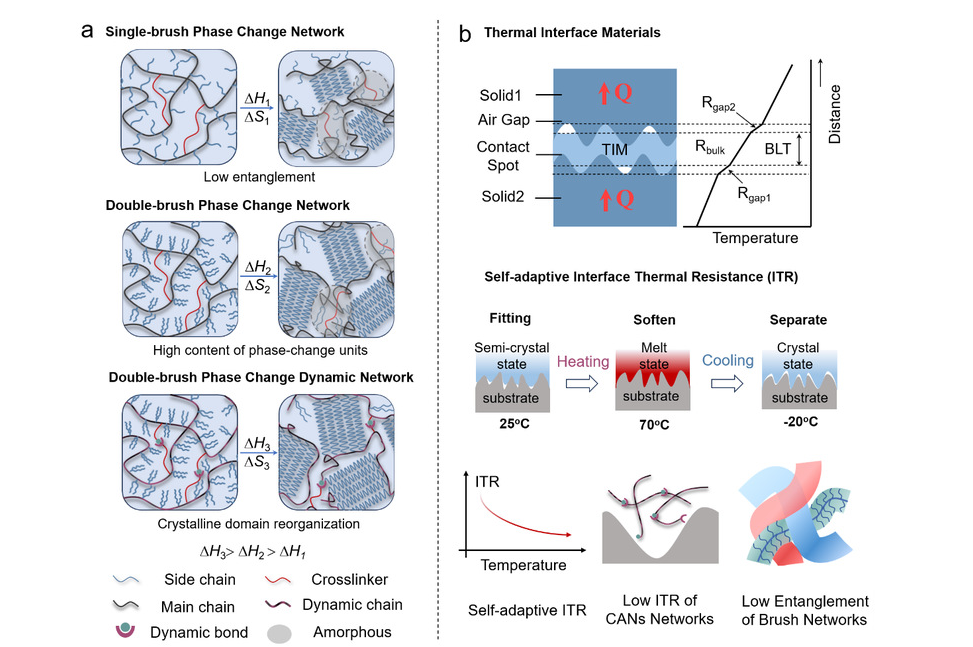
As the power density of electronic devices continues to increase, thermal management has become a critical factor limiting their performance and reliability. Traditional phase-change thermal interface materials often face challenges such as limited latent heat values, high interfacial thermal resistance, and difficulty in recycling and reuse. This study innovatively employs a dual-brush topological design to maximize phase-change unit content. It introduces dynamic B-O-B and Si-O-B bonds to form a covalent adaptive network, further reducing enthalpy loss beyond low-entanglement brush networks. This unique structure achieves a melting enthalpy of 240.7 J·g. Simultaneously, the dynamic bonds confer ultra-fast network rearrangement capability, while ultrafast relaxation endows the material with outstanding adaptability, interfacial wettability, and reprocessing performance. A flexible phase-change material was further developed using a co-grafting method for long and short chains. By combining a stack-and-cut strategy with graphene foam films, a layered thermal interface material was fabricated. This composite exhibits a thermal conductivity of 55.5 W·m·Kand demonstrates extremely low adaptive interfacial thermal resistance. In practical CPU thermal testing, compared to commercial phase-change thermal interface materials, it significantly reduces steady-state CPU temperatures by 10–15°C and peak temperatures by 8–10°C, demonstrating outstanding thermal management performance. This work overcomes the performance limitations of traditional materials through ingenious topological and dynamic chemical design, paving a new path for developing next-generation intelligent, efficient, and sustainable thermal management materials.
The first author is Liu Qiguang, a 2023 direct-entry doctoral student from the School of Materials Science and Engineering at Beijing University of Chemical Technology. Professor Zhang Junying and Lecturer Ma Jiahao from the same institution served as co-corresponding authors, with Beijing University of Chemical Technology listed as the primary completing institution. This research received funding from the National Natural Science Foundation of China, the China Postdoctoral Science